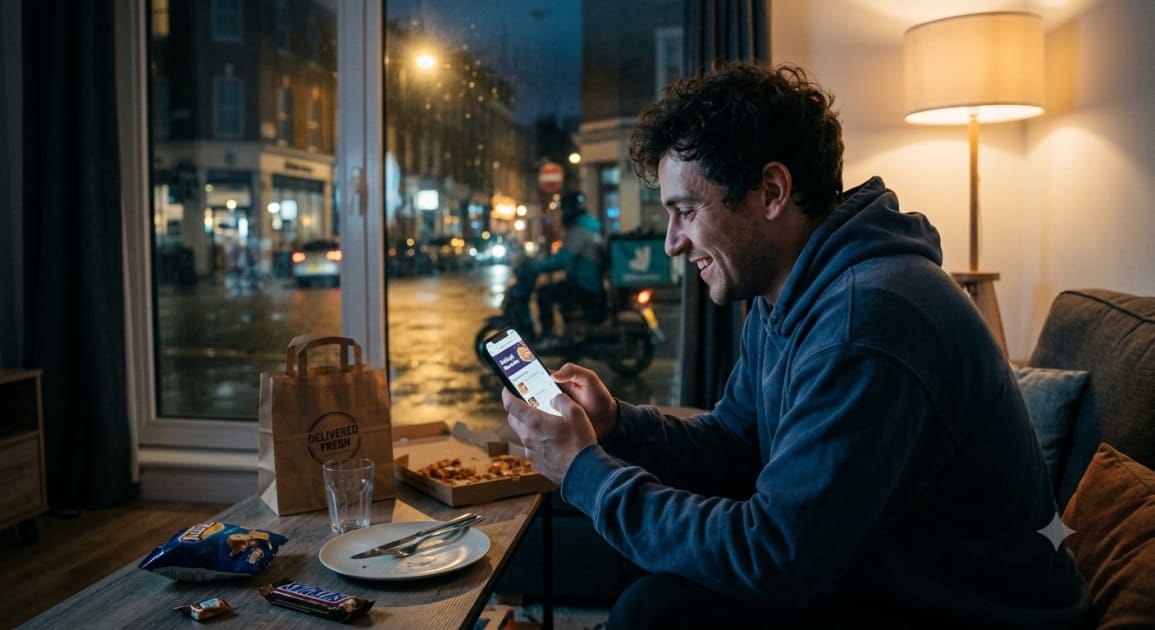
Ask any food delivery rider in Bengaluru what their busiest hour is, and don't be surprised if the answer is closer to midnight than dinnertime. Between 11 PM and 2 AM, orders spike across Koramangala, HSR, Indiranagar, and the tech corridors near Electronic City and Whitefield. This isn't just "the city that never sleeps" — there's a fairly specific psychology behind why Bengaluru orders food so late, and it says a lot about how the city actually lives. It's Not Really About Hunger Late-night ordering rarely starts with genuine physical hunger. More often, it's one of a few very specific triggers: Decision fatigue after a long work day — by 11 PM, cooking (or even deciding what to cook) feels like one more task on a day that's already had too many. Reward-seeking behavior — after a stressful day or a late deadline, ordering food functions less as a meal and more as a small, controllable win. It's the "I made it through today" order. Social eating without the social part — a late-night order paired with a show or a call with a friend replaces the shared meal many people don't have time for earlier in the day. The 24-hour work culture effect — with a large share of Bengaluru working late shifts, split hours with global teams, or simply staying up to unwind after a packed day, "dinner time" has quietly shifted for a big chunk of the city. Why Bengaluru Specifically A few things about this city make the late-night pattern more pronounced here than in most Indian metros: 1. Long, unpredictable commutes mean dinner plans made at 7 PM often don't survive contact with an 8:30 PM arrival home. 2. A young, largely single or newly-relocated population — students, WFH professionals, and new-to-the-city workers — who don't always have someone cooking at home or a stocked kitchen to fall back on. 3. A tech-heavy workforce with global client calls, meaning "end of day" for a lot of Bengaluru genuinely happens closer to 10 or 11 PM than 6 PM. 4. A dense, always-open delivery ecosystem, which makes ordering at midnight feel as normal as ordering at noon — the friction that used to stop late-night ordering (limited options, long wait times) has mostly disappeared. The Loop That Keeps It Going Late-night ordering tends to reinforce itself in a fairly predictable loop: a long day leads to low energy for cooking, which leads to an order, which delays the next meal's planning, which means the next day starts with an empty fridge too. Over a few weeks, this quietly becomes the default pattern rather than the occasional treat it started as — not because anyone decided to eat out every night, but because nothing interrupted the loop. What Actually Breaks the Pattern The data (and plenty of anecdotal evidence from Bengaluru's own WFH and tech crowd) suggests the loop isn't broken by willpower alone — it's broken by removing the friction on the other side: making a home-cooked or ready-to-eat option as fast and low-effort as the late-night order itself. This is part of the thinking behind Swadishtt, Accesco Living's food vertical — not positioning itself as "don't order out," but making authentic, home-style food (from home chefs and trusted local kitchens) available with the same convenience that currently pulls people toward impulse late-night orders. Paired with Grokly's predictive grocery restocking, the goal is to make sure the fridge isn't empty in the first place, so the 11 PM decision isn't a forced one. Bengaluru's late-night food delivery boom isn't really about the city being hungry after midnight — it's about long days, shifted schedules, and a delivery ecosystem that removed every reason to wait until morning. Understanding that is the first step to actually working with it, rather than fighting it.
The Psychology Behind Bengaluru's Late-Night Food Delivery Boom
Business
August 10, 2026
About Accesco Living
Learn more about usExperience India's Everyday Living App
Be among the first to explore Grokly, Swadisht & InstaStyle before the Bengaluru launch.