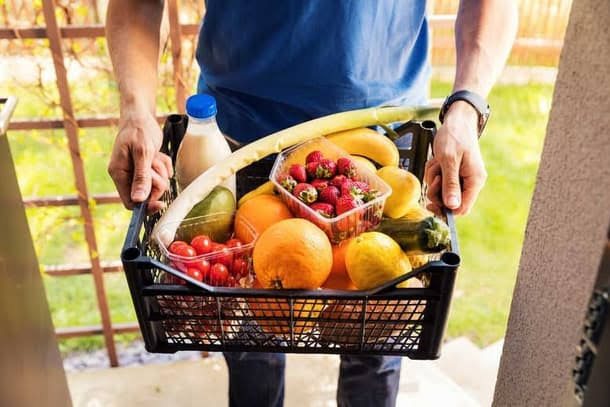
Intelligent grocery delivery works by learning a household's actual buying patterns over time and using that pattern to predict what's needed before it runs out, rather than simply waiting for someone to manually place an order. Regular quick commerce focuses almost entirely on fulfilling whatever's ordered as fast as possible, treating every order as a standalone event with no memory of what came before it. Intelligent delivery adds a layer on top of that speed, noticing that a household reorders rice every ten days or milk every few days, and using that pattern to prompt a timely reorder instead of leaving the household to notice they've run out on their own.
The core difference isn't really about speed at all, both models can deliver quickly once an order is placed. The difference is in what happens before the order. Regular quick commerce assumes the shopper will always remember what's needed and manually search or rebuild a cart each time. Intelligent grocery delivery treats that memory problem as something the app itself can help solve, reducing the mental effort of tracking household staples manually every single week.
This distinction matters most for the kind of small, repetitive grocery needs that make up most of an average household's spending, staples like grains, dairy, and basic cooking essentials that get bought on a fairly predictable cycle. A system that recognises this cycle can flag a reorder before the item is actually gone, rather than the household discovering the gap mid cooking and needing an urgent, often more expensive, last minute order to fix it.
Grokly's predictive reordering is built around exactly this principle, using a household's own order history rather than a generic citywide average to understand what that specific household actually needs and when. It's less about being faster than standard quick commerce and more about needing less manual effort from the shopper to get groceries at the right time.
Frequently Asked Questions Is intelligent grocery delivery more expensive than regular quick commerce? Not inherently. Pricing generally depends on the items ordered and delivery model rather than whether the app uses predictive features. In practice, reducing last-minute, urgent orders through better prediction can actually lower total monthly spending by cutting down on convenience fees from reactive ordering.
Does intelligent grocery delivery require me to give up control over what I order? No. Predictive features typically suggest or prompt reorders rather than placing them automatically without confirmation. The shopper still decides what to add, skip, or change, the app simply reduces the manual effort of remembering what's likely needed.
How long does an app need to learn a household's grocery pattern? This varies, but most predictive systems start showing useful patterns within a few weeks of regular ordering, since staples like rice, milk, and household basics tend to follow fairly consistent short cycles. The more consistently a household orders through one app, the faster and more accurate the pattern recognition becomes.
Can intelligent grocery delivery work for irregular or unpredictable households? It works less precisely for households with highly irregular shopping patterns, since prediction relies on some consistency to identify a cycle. Even in less predictable households, though, it can still highlight commonly repeated purchases, just with wider reorder windows rather than precise timing.
Is predictive grocery delivery the same as a subscription service? No. A subscription typically charges automatically on a fixed schedule regardless of actual need. Predictive grocery delivery prompts a suggested reorder based on real usage patterns, but the shopper still chooses whether to place that order each time, which keeps it more flexible than a locked-in subscription.