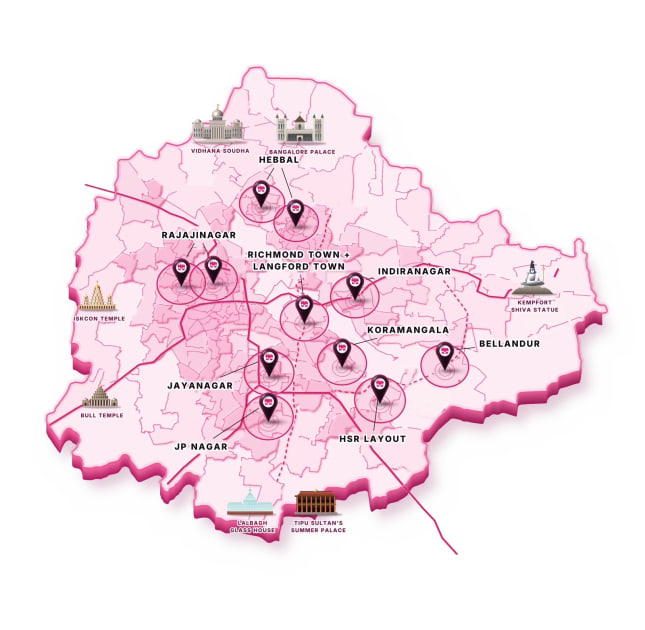

Accesco Living is preparing for its Bengaluru launch with a cluster-first approach, using ground-level demand mapping to decide where the business should build its initial presence.
Rather than attempting to cover the entire city from day one, the company has identified nine priority locations across Bengaluru: Hebbal, Rajajinagar, Richmond Town and Langford Town, Indiranagar, Koramangala, Jayanagar, JP Nagar, HSR Layout and Bellandur.
The locations span established residential neighbourhoods, commercial districts and high-density urban catchments, giving Accesco an opportunity to test its everyday living model across different types of consumers and neighbourhoods.
Why demand mapping matters
For a business built around groceries, food and everyday essentials, simply having a large addressable market is not enough.
The economics depend heavily on where customers live, how frequently they order, how close households are to one another, what products they need, how supply can be organised and how efficiently deliveries can be completed.
Accesco’s demand mapping approach looks at these factors at the neighbourhood level.
The objective is to identify areas where customer demand can be concentrated enough to build operational density instead of spreading resources thinly across Bengaluru.
This matters particularly for Accesco because its model goes beyond simply delivering an order.
The company is building an everyday experience that connects sourcing, groceries, food, household planning, doorstep checking and recovery. For that model to work efficiently, the underlying delivery and supply network needs enough density.
The nine Bengaluru clusters
Hebbal
Hebbal represents one of the northern Bengaluru clusters identified on Accesco’s launch map.
Its location gives the company access to a large urban catchment while also providing an important northern entry point for the initial network.
Rajajinagar
Rajajinagar forms another major western Bengaluru cluster.
The area gives Accesco an opportunity to test its model across established residential neighbourhoods and build concentrated demand within a defined operating zone.
Richmond Town and Langford Town
Richmond Town and Langford Town have been mapped together as a priority cluster.
The central location places this cluster within a wider network of established residential and commercial areas, making it relevant for testing everyday grocery and food demand.
Indiranagar
Indiranagar is one of the prominent eastern-central clusters on the map.
For Accesco, it provides an opportunity to understand everyday consumption patterns in a neighbourhood with a strong mix of residential and commercial activity.
Koramangala
Koramangala is another important launch cluster.
The neighbourhood gives Accesco access to a dense urban consumer base and an environment where frequent food, grocery and everyday-need purchases can be tested.
Jayanagar
Jayanagar represents one of the southern Bengaluru clusters selected for the initial network.
Its established residential character makes it relevant to Accesco’s focus on recurring household needs rather than only last-minute purchases.
JP Nagar
JP Nagar extends the southern cluster coverage.
Together with Jayanagar and HSR Layout, it can help Accesco build greater operating density across the southern part of the city.
HSR Layout
HSR Layout is another key southern Bengaluru location on the launch map.
The cluster provides a strong setting to study recurring grocery, food and household demand while building a connected delivery network across nearby neighbourhoods.
Bellandur
Bellandur forms the easternmost cluster shown on the current map.
Its inclusion gives Accesco a presence in an important eastern Bengaluru catchment and expands the initial network towards one of the city’s major employment and residential corridors.
Building density before building distance
The thinking behind the launch is straightforward: build density before attempting broad city-wide coverage.
A concentrated cluster can support better utilisation of delivery capacity, more efficient inventory planning and stronger understanding of local demand.
It can also make Accesco’s planned post-delivery services more practical.
For example, Doorstep Check is designed to allow customers to check eligible sealed products before accepting them. Eco Return is designed to bring eligible packaging and recoverable materials back through existing delivery routes where recovery is viable.
Both concepts become easier to operate when deliveries are concentrated within defined neighbourhoods.
The same principle applies to sourcing.
If Accesco understands what households in a cluster repeatedly purchase, that demand can become a stronger signal for procurement and sourcing decisions.
From neighbourhood demand to a larger network
The Bengaluru launch is therefore more than a geographic expansion plan.
It is also a way for Accesco to learn how households behave at neighbourhood level.
Grokly focuses on groceries and everyday essentials, while Swadishtt connects the same household demand to food and meals. TRACO is designed to turn household requirements into planned purchasing and demand signals.
As these products operate together, each cluster can provide Accesco with a clearer picture of what households buy, how frequently they buy it and what they are likely to need next.
That information can eventually support a broader sourcing and fulfilment network.
The company’s longer-term direction also includes Hyper Chain for B2B procurement, dedicated recovery operations and White Label FMCG and food products.
Bengaluru is the starting point
Accesco Living is not trying to launch everywhere at once.
The current map shows a deliberate attempt to start with selected Bengaluru clusters, understand the economics of concentrated demand and build the operational foundation required for a larger network.
The nine locations currently identified are:
Hebbal | Rajajinagar | Richmond Town + Langford Town | Indiranagar | Koramangala | Jayanagar | JP Nagar | HSR Layout | Bellandur
The larger ambition is to make everyday shopping less fragmented.
For Accesco, that starts at the neighbourhood level.
India’s Everyday Living App. Smartly simplified for everyday India.